Four Offers Slide Template for Business Data: A Strategic Framework for Clearer Decisions
Presenting business data effectively is rarely about the volume of information you have. More often, it is about how you structure that information for the people who need to act on it. The Four Offers Slide Template, applied to business data, is not simply a design convenience. It is a strategic tool that forces clarity, encourages comparison, and helps decision-makers move from raw numbers to actionable insights. When used thoughtfully, this template transforms a crowded slide into a focused narrative about value, choice, and outcome.
Why the Four Offers Slide Template Changes How You Present Data
Most business presentations suffer from a common problem: they try to say everything at once. A single slide packed with rows of figures, multiple charts, and dense annotations may contain valuable information, but it rarely communicates that value effectively. The Four Offers Slide Template solves this by imposing a natural constraint. You have four spaces, four columns, or four panels. That limitation is not a weakness. It is a discipline that forces you to decide what matters most.
When you apply this template to business data, you are essentially curating your information into four distinct offers, options, or perspectives. This could mean four pricing tiers, four quarterly results, four strategic initiatives, or four customer segments. The structure itself invites comparison. Your audience can see the differences side by side, weigh trade-offs, and form conclusions faster than if they had to process a monolithic data dump.
From a strategic standpoint, this approach supports better positioning. If you are presenting a product line, the four offers allow you to clearly differentiate each tier. If you are reviewing performance data, four quadrants can help you highlight outliers or trends that might otherwise get buried. The template becomes a lens through which your data gains meaning.
Using the Template to Support Planning and Decision-Making
One of the most practical uses of the Four Offers Slide Template is in planning sessions. Imagine you are a marketing manager evaluating four campaign strategies. Each column in the template can represent a different approach, with rows for cost, reach, conversion rate, and projected revenue. The visual comparison makes it immediately clear which option offers the best balance of risk and reward.
For entrepreneurs and small business owners, this template is especially valuable when making resource allocation decisions. You have limited time, budget, and attention. Seeing four options laid out with their key metrics allows you to make trade-offs with confidence. You are not guessing. You are comparing structured data.
Consider a scenario where you are planning the next quarter's product launches. You have four potential products, but only enough capacity to pursue two seriously. The Four Offers Slide Template lets you stack up expected demand, margin, development time, and strategic fit in a single view. The decision becomes less about intuition and more about evidence. That is the kind of clarity that drives long-term results.
Positioning and Communication Benefits
The template also excels at positioning. If you are presenting to investors, board members, or key clients, your ability to communicate quickly and clearly builds credibility. A slide that uses the four-offer structure signals that you have done the work of prioritization. You are not asking your audience to sift through raw data. You are offering them a curated perspective. That is a sign of professional maturity.
For educators and trainers, the template can be used to present four learning modules, four case studies, or four stages of a process. Learners benefit from the clear structure because it reduces cognitive load. They can focus on understanding the relationships between the elements rather than trying to decode the layout.
Freelancers and consultants will find the template useful when presenting service packages. Instead of describing each offering in paragraph form, you can show a side-by-side comparison of scope, deliverables, timeline, and investment. Clients appreciate this transparency, and it often leads to faster decisions because they can see exactly what each option includes.
When to Use the Four Offers Slide Template and When to Avoid It
Not every data set fits neatly into four categories. The key is to recognize when the template adds value and when it forces an unnatural structure. Use it when you have four distinct items that benefit from direct comparison. Avoid it when your data is continuous, when you have more than four natural groupings, or when the relationships between items are not comparative but sequential or hierarchical.
For example, if you are presenting a timeline of milestones, a linear layout might serve you better than four columns. Similarly, if you have six pricing tiers, forcing them into four boxes could misrepresent your offerings. In those cases, modify the template or choose a different structure. The template is a tool, not a rule.
Another consideration is context. If your audience is already familiar with the data, the template may feel overly simplified. But for a new audience or a high-stakes presentation where clarity is critical, the four-offer structure can be a powerful ally. Gauge your audience's familiarity and adjust accordingly.
Practical Examples of the Template in Action
Let me walk through a few realistic use cases to show how the Four Offers Slide Template can support different goals.
Example 1: Marketing Campaign Analysis
A marketing team needs to present the performance of four campaigns from the previous quarter. Each column represents one campaign. Rows include impressions, click-through rate, cost per acquisition, and total conversions. The slide makes it immediately obvious which campaign delivered the best return and which one underperformed. The team can then discuss why and plan adjustments.
Example 2: Pricing Strategy Review
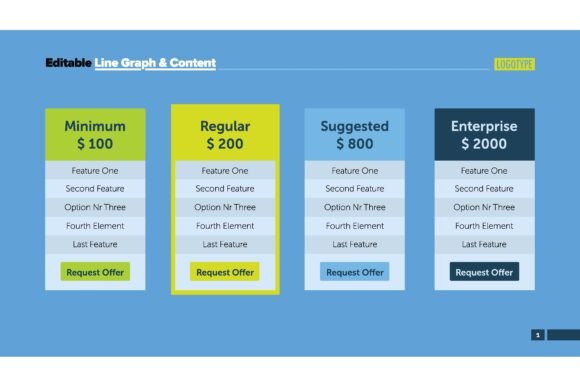
A SaaS startup is considering four pricing tiers. The slide shows features, limits, support level, and price for each tier. The leadership team can see at a glance whether the tiers are clearly differentiated or whether there is overlap that might confuse customers. This leads to a more thoughtful pricing structure before launch.
Example 3: Operational Efficiency Report
A operations manager wants to compare four warehouses on metrics like order accuracy, shipping time, inventory turnover, and cost per order. The slide reveals which facility is excelling and which needs process improvement. The visual comparison supports a focused action plan rather than a general review.
Example 4: Customer Segment Analysis
A small business owner examines four customer segments based on average order value, purchase frequency, retention rate, and lifetime value. The template helps identify which segment is most profitable and which may need more attention or a different approach.
Risks of Using the Template Without Clear Goals
No tool is foolproof, and the Four Offers Slide Template can backfire if used carelessly. The most common risk is forcing data into four categories when it does not belong there. This can create misleading comparisons or hide important nuances. If you have five strong candidates for a strategic initiative, presenting only four could make your analysis seem incomplete or biased.
Another risk is focusing too much on the visual structure and not enough on the data quality. A beautiful slide with weak or inaccurate data does not serve anyone. The template should highlight good data, not disguise bad data. Always verify your numbers before placing them in the slide.
There is also the risk of oversimplification. Some business situations are genuinely complex and require more than a four-column view. If you use the template for a topic that demands nuance, you might give your audience a false sense of certainty. Be honest about what the template can and cannot show.
Finally, avoid using the template as a crutch. If every presentation you create follows the same four-offer structure, your audience may start to see it as formulaic. Vary your formats based on the content and the message you want to convey. Strategic communication requires flexibility, not rigidity.
Tips for Using the Template Intentionally
To get the most out of the Four Offers Slide Template, start with a clear purpose. Ask yourself: What decision do I want my audience to make? What comparison is most important? Once you have that clarity, choose your four items deliberately. They should be meaningful, distinct, and directly relevant to the decision at hand.
Next, think about the rows or data points you include. Each row should contribute to the comparison. Avoid filler metrics that look good but do not inform. If a row does not help someone choose or understand, remove it. Less is more when it comes to decision support.
Consider ordering your columns intentionally. You might place the most attractive option on the left, or you might order them from low to high price. The sequence should guide the viewer naturally toward the conclusion you want them to reach. That is not manipulation. It is thoughtful communication.
Also, pay attention to design details. Consistent formatting, clear labels, and appropriate color coding make the template easier to scan. But avoid over-designing. The data should remain the hero of the slide. Let the structure support the information, not overshadow it.
Long-Term Value for Your Business and Brand
Adopting the Four Offers Slide Template as part of your regular presentation toolkit can have lasting benefits. Over time, your audience will come to expect clear, structured communication from you. That builds trust. When people trust your presentations, they are more likely to act on your recommendations.
For your own planning processes, the discipline of distilling information into four key offers or perspectives sharpens your thinking. You become better at identifying what truly matters and letting go of the rest. That skill translates into better strategies, stronger proposals, and more focused execution.
In branding and customer experience, the template can be used to communicate value propositions clearly. Customers appreciate knowing exactly what they are getting and how options compare. A well-structured offer slide can reduce confusion, shorten sales cycles, and improve satisfaction because expectations are set accurately from the start.
Final Thoughts on Strategic Use
The Four Offers Slide Template is more than a design shortcut. It is a strategic framework that, when used with intention, can improve how you analyze, present, and decide on business data. Whether you are an entrepreneur mapping out your next move, a marketer comparing campaign performance, or a leader guiding a team through a planning cycle, this template offers a practical way to bring clarity to complexity.
The key is to use it thoughtfully. Know why you are choosing four items. Ensure your data is accurate and relevant. Design for clarity, not flash. And always remember that the goal is not to fill a slide, but to inform a decision. When you approach the template that way, it becomes a reliable ally in your communication toolkit.
Take time to experiment with it in low-stakes situations before relying on it for major presentations. Learn how it works with your data and your audience. Over time, you will develop a feel for when it fits and when another structure would serve better. That judgment is what separates effective communicators from those who simply reuse templates without thought.
The Four Offers Slide Template, applied to business data, is a deceptively simple tool. Its real power lies not in its design, but in the discipline it imposes on how you think and what you share. Embrace that discipline, and your presentations will become more than slides. They will become catalysts for better decisions.