Arafah Night Scene: A Visual Tribute to One of Islam’s Most Sacred Moments
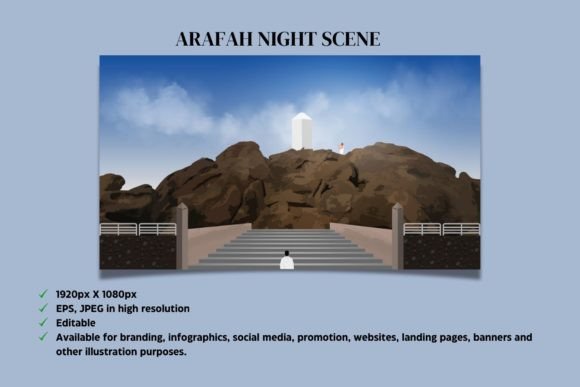
The image of Mount Arafat under a quiet, star-filled sky carries a weight that transcends mere illustration. It captures a moment of profound spiritual significance — the eve of the Day of Arafah, when millions of pilgrims stand in prayer on the plain below. This particular Arafah Night Scene, rendered in high resolution with careful attention to light, symbol, and typography, speaks to a growing need for authentic, visually compelling representations of Islamic traditions. For creators, marketers, and educators working within or alongside Muslim communities, such imagery is not just decorative. It is a bridge between heritage and modern communication, offering a way to convey reverence without losing clarity or impact.
The Deeper Meaning Behind the Arafah Night Scene
To understand why this artwork resonates, one must first appreciate what it represents. Mount Arafat, or Jabal Arafat, is the hill where the Prophet Muhammad delivered his final sermon during the Hajj pilgrimage. The Day of Arafah, which falls on the 9th day of the Islamic month of Dhul Hijjah, is considered the most sacred day in the Islamic calendar. Standing at the base of this mountain, a pilgrim engages in supplication and reflection, seeking mercy and spiritual renewal.
The illustration captures that stillness. The white pillar atop the mountain — a landmark known as the Hill of Mercy — stands illuminated under a crescent moon. The pilgrim at the base appears small against the vastness of the landscape, a visual reminder of humility before the divine. Arabic calligraphy and the English phrase “The Day of Arafah” anchor the scene in both cultural tradition and accessibility. By combining these elements, the artwork becomes more than a picture; it becomes a tool for storytelling, education, and emotional connection.
How Islamic Visual Content Has Evolved in Recent Years
There was a time when imagery related to Islamic events was either highly abstract or limited to simple icons. Photographs of pilgrimage sites were common, but illustrated interpretations that balanced spiritual gravity with modern design sensibilities were harder to find. That has changed. Today, audiences expect visual content that is both culturally specific and professionally polished. The Arafah Night Scene reflects this shift. It uses a cinematic composition — a 1920px by 1080px resolution — that aligns with contemporary display standards for websites, social media, and digital advertising.
This evolution is driven by several factors. First, the Muslim digital audience is young, global, and visually literate. Second, brands and organizations increasingly recognize the need to represent religious moments with nuance and beauty rather than with stock imagery that feels generic. Third, the rise of Islamic lifestyle content — from modest fashion to halal travel — has created demand for visuals that support authentic storytelling. The Arafah Night Scene fits naturally into this landscape, offering a ready-made backdrop for campaigns, educational materials, and reflective posts alike.
Why High Resolution and File Versatility Matter for Modern Projects
The practical value of an image often depends on how flexibly it can be used. At 1920px by 1080px, this illustration meets the resolution requirements for full-screen web backgrounds, video thumbnails, banner ads, and presentation slides. It is crisp enough to hold detail on large displays while remaining lightweight enough for fast loading — an important consideration for site performance and user experience.
Moreover, the availability of both EPS and JPEG formats addresses different workflow needs. EPS files are vector-based, which means they can be scaled infinitely without losing quality. This is essential for print materials such as brochures, posters, or event programs where sharpness matters. JPEG files, on the other hand, are immediately usable for digital platforms without requiring additional software. For a freelance graphic designer preparing a Ramadan campaign or a social media manager scheduling posts for the Hajj season, having both formats eliminates the need to convert or re-export files, saving time and preserving design integrity.
Practical Applications Across Platforms and Audiences
One of the strongest features of this artwork is its adaptability. Let’s consider a few realistic use cases:
- Social media storytelling – A brand or influencer can use the image as the backdrop for a post about the spiritual meaning of Arafah. The combination of English and Arabic text makes it accessible to a diverse following, while the night sky conveys a mood of contemplation that aligns well with reflective captions.
- Website and landing page design – Islamic charities, tour operators offering Hajj packages, and educational platforms covering Islamic studies can use this illustration as a hero image. The high resolution ensures it looks professional on both desktop and mobile viewports, and the subdued color palette does not distract from calls-to-action or key text.
- Infographics and educational content – The image can serve as a visual anchor for infographics explaining the stages of Hajj or the significance of the Day of Arafah. Its clear focal points — the mountain, the pillar, the pilgrim — make it easy to overlay data, timelines, or key quotes without creating visual clutter.
- Promotional and branded materials – Organizations creating email newsletters, digital invitations for iftar events, or printed flyers for community gatherings can rely on the EPS file for print-quality output. The illustration’s reverence also makes it suitable for non-commercial uses, such as mosque bulletins or interfaith dialogue materials.
Design Considerations When Using Religious Imagery
Working with content that carries deep spiritual meaning requires care. The goal is to honor the subject while meeting the needs of the project. This illustration succeeds because it does not oversimplify or sensationalize. The pilgrim is present but not dominant, the calligraphy is integrated rather than superimposed, and the overall tone is serene rather than dramatic. For designers and content creators, this offers a useful template: let the visual elements speak to the sacredness of the moment without adding unnecessary flourish.
When incorporating such imagery into a layout, consider the following:
- Typography placement – The existing calligraphy and “The Day of Arafah” text are part of the image, so avoid crowding additional text near them. Use negative space in the sky or the lower portion of the image for headlines or captions.
- Color harmony – The night sky uses deep blues and blacks, while the mountain and pillar have warm, muted tones. Pair this image with neutral or earth-tone accent colors to maintain cohesion across the design.
- Cultural sensitivity – Always verify that the usage context is appropriate. For example, using this image on a landing page for a travel agency’s Hajj package would be fitting, while placing it on a generic sale banner might feel misaligned. Respect the subject matter by choosing contexts that reflect its significance.
What This Artwork Reveals About Broader Market Trends
The demand for high-quality Islamic visual content is not a passing phase. It reflects a larger movement toward representation and specificity in media. Audiences today are quick to notice when an image has been repurposed from a generic stock library without regard for cultural authenticity. Conversely, they respond positively to visuals that feel intentional and informed. The Arafah Night Scene meets this expectation by combining religious accuracy with contemporary aesthetic standards.
For businesses and creators, investing in such imagery signals an understanding of the audience’s values. It acknowledges that the Day of Arafah is not just a date on a calendar but a deeply emotional occasion for millions of people worldwide. Whether the goal is to educate, inspire, or connect, starting with an image that respects that reality creates a foundation of trust. And in an age where brand loyalty is increasingly tied to shared values, that trust is worth its weight in gold.
Practical Recommendations for Downloading and Using the Image
If you plan to incorporate this illustration into a project, take full advantage of its format options. Download the JPEG version for rapid prototyping, social media mockups, or any place where you need a quick preview. Use the EPS file for final print production, large-scale banners, or any application where scaling and editing flexibility are required. Keep a master copy of the EPS file in your asset library, along with appropriate metadata tags such as “Arafah,” “Hajj,” “Mount Arafat,” “Islamic illustration,” and “night scene” for easy retrieval in future projects.
For teams working across multiple platforms, consider resizing the JPEG version to create a cohesive set of graphics — a 1200x630 version for social sharing, a 1920x1080 version for website headers, and a 1080x1080 square crop for Instagram posts. Because the original image is high resolution and well-composed, these adaptations will retain their quality and visual impact.
Closing Thoughts on Capturing the Spirit of Arafah
The Arafah Night Scene does more than depict a place. It evokes a moment of quiet intensity — the hours before dawn, the weight of prayer, the vastness of the sky over a landscape that has witnessed centuries of faith. In a digital world crowded with fleeting visuals, images that carry this level of meaning stand apart. They offer creators and communicators a way to speak to the heart, not just the eye. And for anyone tasked with representing Islamic traditions in a respectful, beautiful, and effective manner, that is a rare and valuable resource.