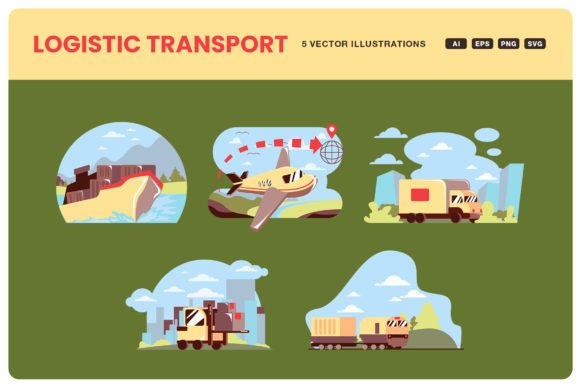
Logistic Transport Illustration: Visualizing Modern Supply Chains
In a world where supply chains move faster than ever, communicating complex logistics concepts clearly is a real advantage. Whether you are building a website for a freight company, designing a mobile app for fleet tracking, or preparing an analytical report on shipping efficiency, the right visuals can make all the difference. That is where logistic transport illustration steps in — not as a decorative afterthought, but as a functional tool for clarity, engagement, and professionalism.
Traditional stock photography often feels generic, outdated, or culturally mismatched. Illustrations, on the other hand, offer flexibility and a clean, modern aesthetic that resonates with today’s audiences. A well-crafted logistic transport illustration set gives you the ability to represent trucks, cargo ships, delivery vans, warehouses, and supply chain flows in a consistent, on-brand style. This matters because people process visuals faster than text, and in business contexts, every second of engagement counts.
Why Logistic Transport Illustration Matters Now
The logistics industry has undergone a dramatic transformation over the past decade. E-commerce growth, real-time tracking expectations, and sustainability goals have pushed supply chain communication to the forefront. Professionals in marketing, product design, and content creation now need images that reflect speed, reliability, and transparency — not just a truck on a road.
Logistic transport illustration answers this need by offering scene-specific visuals that can be tailored to different audiences. For example, an infographic about last-mile delivery challenges benefits from a clear, vector-based illustration of a delivery drone or a van navigating a city map. A presentation for investors might use a stylized cargo ship to discuss global trade routes. The versatility of an illustration set means you are never forced to compromise on message or aesthetics.
Additionally, customizability is no longer a luxury — it is an expectation. Modern teams work across platforms and formats, and they need assets that adapt without losing quality. A vector logistic transport illustration set, with editable colors and scalable file types, supports everything from a small blog post to a large-format trade show display. This adaptability is why more designers and marketers are moving away from static photography and toward illustration-based visual systems.
How Logistic Transport Illustration Has Evolved
Early logistics visuals were largely diagrammatic — think clip art of a truck or a warehouse silhouette. They served a basic function but lacked depth, style, and emotional resonance. Over time, as user experience design matured, the demand for more refined, contextual illustrations grew. Logistic transport illustration evolved from simple icons into full-scene compositions that tell stories: a package moving from a factory floor to a doorstep, or a global map dotted with shipping hubs.
Part of this evolution stems from design trends like flat vector art, isometric perspectives, and character-driven scenes. These styles feel approachable and modern, making complex logistics topics more accessible. For instance, an isometric logistic transport illustration of a distribution center helps viewers intuitively understand spatial relationships and workflow sequences. Similarly, a character illustration showing a warehouse worker scanning a package adds a human element that statistics alone cannot convey.
Another shift is the move toward modular illustration sets. Instead of purchasing one-off images, professionals now seek cohesive collections that share a consistent color palette, line weight, and style. A logistic transport illustration set provides this coherence, allowing you to mix and match elements across a project — from a mobile app onboarding screen to a slide in a quarterly review presentation. This modular approach saves time, maintains brand consistency, and reduces the need for costly custom illustration work.
Practical Implications for Professionals and Creators
For business owners and marketers, the practical value of having a versatile illustration set is difficult to overstate. Consider a startup building a logistics management platform. The landing page needs to communicate speed and reliability within seconds. A custom illustration of a delivery van with a glowing path across a cityscape does this far more effectively than a generic photo. Moreover, because the files come in editable formats like AI, EPS, and SVG, the startup’s designer can quickly adjust colors to match the brand palette without starting from scratch.
Freelancers and consultants also benefit. When preparing a client presentation about supply chain optimization, you want visuals that look professional and polished, not like recycled clip art. A logistic transport illustration set gives you high-resolution, scalable graphics that work seamlessly in slides, handouts, and digital reports. The PNG versions are ideal for quick placement, while the SVG files allow for crisp rendering on screens of any size.
Educators and content creators find illustration sets useful for explaining nuanced topics. For example, a blog post about the environmental impact of different transport modes can pair a visual comparison of a diesel truck and an electric van. An article about warehouse automation can use a step-by-step illustrated flow. These visuals not only break up text but also anchor key points in the reader’s memory. The 2000×2000 px resolution ensures that even cropped or zoomed details remain sharp.
Making the Most of File Format Flexibility
One of the strongest features of a logistic transport illustration set is the range of file formats provided. AI files (Adobe Illustrator) are standard for professional designers who need full control over layers, strokes, and effects. EPS files offer compatibility across older vector software, making them a safe choice for collaborative projects. SVG files are essential for web and app development because they scale infinitely and can be styled with CSS. PNG files, on the other hand, are convenient for quick use in documents, email newsletters, or social media graphics.
Having this range means you are never locked into one workflow. A UI designer can import the SVG directly into Figma or Sketch. A presentation specialist can drag the PNG into PowerPoint or Google Slides. An illustrator can open the AI file to tweak shadows or reorganize composition. This flexibility reduces friction in team collaboration and speeds up project timelines. For anyone juggling multiple content formats — which is most of us — this is a genuine time saver.
Where Logistic Transport Illustration Makes the Biggest Impact
The most effective applications tend to be customer-facing and stakeholder-facing. In website design, illustrations create immediate visual interest and help convey a company’s mission. A logistics firm that uses custom illustrations across its homepage, service pages, and blog establishes a cohesive brand identity that feels intentional and trustworthy. Mobile apps, especially those focused on delivery tracking or fleet management, benefit from illustrations that guide users through screens without overwhelming them with text.
Infographics remain a powerful medium for communicating data-heavy content. A logistic transport illustration set allows you to build infographics that are both informative and visually consistent. For instance, you might illustrate a timeline of a shipment’s journey, using icons and small scenes to represent each step: pickup, sorting, transit, delivery. The result is an infographic that reads like a story rather than a spreadsheet.
Analytical reports — often dense and dry — become more digestible when punctuated with relevant illustrations. A chart showing regional delivery times can be paired with a small illustration of a cargo truck or an airplane, reinforcing the context without distracting from the data. Website templates, too, gain a competitive edge when they include high-quality illustration sets. Clients are often willing to pay a premium for templates that look complete and unique, and well-drawn illustrations raise that perceived value.
Practical Recommendations for Integrations
When incorporating a logistic transport illustration set into your work, think about consistency first. Choose illustrations that share a visual style — line thickness, shading, color temperature — across all elements. If your set includes both a warehouse scene and a delivery van, make sure they feel like they belong in the same world. This coherence makes your brand appear more polished and professional.
Next, consider the context of use. For a mobile app interface, simpler, icon-like illustrations work best. For a presentation or infographic, more detailed scenes add depth without becoming distracting. The editable color feature is particularly useful: use it to align illustrations with your brand’s primary color, or to ensure that the visuals remain readable on both light and dark backgrounds.
Finally, do not underestimate the value of having backup formats. While vector files are ideal for editing and scaling, PNG files give you ready-to-use assets when you are on a tight deadline. Keep organized folders for each format, and label your files clearly. This habit saves time and reduces frustration, especially when you are revisiting a project weeks or months later.
Looking Ahead: Sustained Relevance
As logistics continue to evolve — with more automation, electrification, and data integration — the need for clear, adaptable visual communication will only grow. Logistic transport illustration is not just a trend; it is a practical response to the increasing complexity of how goods move around the world. Whether you are a marketer explaining a new delivery service, a designer building a supply chain dashboard, or a business owner pitching to investors, having a reliable set of visuals at your fingertips is a genuine asset.
By choosing a logistic transport illustration set that offers multiple file formats, scalable resolution, and editable colors, you prepare your projects for a range of platforms and audiences. The result is not just better-looking content, but more effective communication — something every professional can appreciate. And in a field where clarity and speed matter, that kind of advantage is well worth investing in.