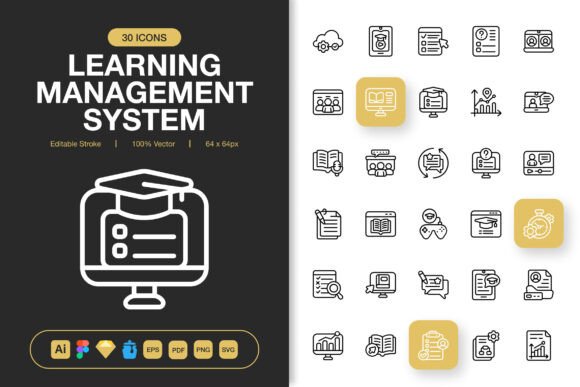
Learning Management System Icons: Elevate Your Digital Projects with Minimalist Design
In today’s fast-paced digital environment, visual communication is no longer an option—it is a necessity. Whether you are building an e-learning platform, designing a mobile app, or preparing marketing materials, the icons you choose directly impact user experience, brand perception, and overall engagement. Among the most versatile and essential icon sets are Learning Management System Icons, which serve as the visual backbone for educational interfaces, training modules, and knowledge-sharing platforms. But these icons are not limited to academic contexts; their minimalist design and high-quality construction make them suitable for any project, from websites and books to infographics, flyers, banners, posters, and social media content.
This article explores the qualities, functions, and practical benefits of using a well-crafted icon set for Learning Management System Icons and beyond. We will examine how minimalist icon design fits into modern workflows across industries, discuss the technical features that matter most to designers and developers, and offer recommendations for integrating these assets into your next project.
The Role of Learning Management System Icons in Modern Design
Icons are more than decorative elements—they are cognitive shortcuts. When users encounter a Learning Management System Icon representing a course, quiz, certificate, or progress bar, they instantly understand the function without reading a single word. This immediacy reduces cognitive load, speeds up navigation, and improves accessibility across different languages and cultures. In e-learning environments, where clarity and efficiency are paramount, a consistent set of icons can transform a cluttered interface into a seamless learning journey.
However, the utility of these icons extends far beyond learning management systems. The same visual language that signals "play video" or "download resource" in an LMS can be repurposed for a marketing campaign, a mobile app onboarding screen, or a printed brochure. The key lies in the design itself: minimalist, scalable, and context-agnostic enough to adapt to diverse applications. A set of high-quality icons with an editable stroke and uniform weight allows designers to maintain visual harmony across multiple touchpoints.
Why Minimalist Icon Design Wins Across Projects
Minimalism in icon design is not about simplicity for its own sake; it is about maximizing clarity with the fewest visual elements. Clean lines, open shapes, and restrained detail ensure that icons remain legible at any size—from a tiny 32-pixel mobile icon to a large 512-pixel banner graphic. This scalability is critical for projects that span multiple formats, such as a website that must also work on social media, in print, and within an app.
Learning Management System Icons designed with a minimalist approach offer several advantages:
- Universal appeal: Minimalist icons transcend trends and cultural differences, making them suitable for global audiences.
- Fast recognition: Users process simple shapes faster than complex illustrations, improving usability.
- Seamless integration: They work with any color palette, background, or typography without clashing.
- Reduced file size: Clean vector paths result in smaller SVG and EPS files, which improves page load speed.
For designers and developers working on tight deadlines, having a set of 100 customizable icons with editable strokes is a game-changer. You can adjust stroke weight, change colors, or modify details without starting from scratch. This flexibility ensures that your icon set feels bespoke, even if it is sourced from a library.
Technical Features That Matter for Real-World Projects
When evaluating an icon set, especially one intended for professional use, the technical specifications can make or break the workflow. The ideal set of Learning Management System Icons should include multiple file formats and source files that allow for easy drag-and-drop integration into popular design tools. Let us break down the features that add real value:
Editable Stroke and Customization
An editable stroke means that every icon is built with vector paths that can be adjusted in thickness, alignment, and style. This is particularly useful when you need to match the stroke weight of your brand typography or when adapting icons for dark mode versus light mode. With a 100 customizable icon set, you can resize, recolor, or rotate elements without degrading quality. This level of control is essential for maintaining consistency across a website, mobile app, and print materials.
Comprehensive File Formats
A professional icon set should provide source files for the most common design environments. The inclusion of Adobe Illustrator, Figma, Iconjar, and Sketch files means that teams can collaborate without friction. Additionally, having an EPS Version 10, PDF, SVG, and PNG transparency variants at multiple sizes (32px, 48px, 64px, 96px, 128px, 256px, 512px) ensures compatibility with any output medium. PNG transparency files are especially valuable for web designers who need to place icons over different backgrounds, while SVG files are ideal for responsive web design because they scale perfectly on retina displays.
Drag-and-Drop Simplicity
Time is a premium resource for any creative professional. Icon sets that include easy drag-and-drop functionality allow designers to place assets directly into their projects without manual import steps. When combined with a well-organized source file, this feature speeds up the design process significantly. Whether you are working on a social media graphic in Figma or a poster in Illustrator, being able to quickly access and place icons keeps the creative flow uninterrupted.
Practical Applications Across Industries and Mediums
The versatility of a minimalist Learning Management System Icons set becomes apparent when you consider the breadth of projects that benefit from consistent visual language. Here are some real-world scenarios where such an icon set shines:
E-Learning Platforms and Educational Websites
This is the most obvious application. Icons for lessons, assessments, achievements, discussions, and progress tracking help students navigate courses intuitively. A well-designed set reduces support requests and improves course completion rates. But beyond the platform itself, these icons appear in promotional emails, social media posts, and printed certificates. Having a unified set ensures that the student experience is consistent from the first ad to the final diploma.
Mobile Applications and User Interfaces
Mobile apps require compact, clear icons that work on small screens. The 32px and 48px PNG versions are ideal for toolbar icons, tab bars, and notification badges. Since touch targets must be precise, minimalist icons with ample negative space prevent accidental taps. Moreover, because the stroke is editable, developers can adjust the icons to match the app's light or dark theme dynamically.
Print Materials: Books, Flyers, Banners, and Posters
Print projects demand high-resolution assets. The included PNG files at 256px and 512px provide excellent print quality for flyers and posters, while vector formats like SVG and EPS ensure that icons remain sharp at larger dimensions, such as trade show banners or book covers. For educators creating handouts or corporate trainers designing workshop materials, having a consistent icon set adds a professional polish that enhances credibility.
Social Media Graphics and Infographics
Social media posts and infographics rely on visual hierarchy to convey information quickly. Learning Management System Icons can be used to illustrate statistics, highlight key features, or structure step-by-step guides. Because the icons are simple and high-quality, they do not distract from the content but instead guide the viewer's eye. The editable stroke also allows for color changes that align with brand guidelines for each social platform.
Factors to Consider Before Choosing an Icon Set
With so many icon libraries available, selecting the right one requires careful thought. Here are several factors that professionals commonly evaluate:
Consistency and Cohesion
The entire set should share a uniform visual language. Every icon should have the same stroke weight, corner rounding, and level of detail. Mixed styles within a set create a disjointed user experience. A curated set of Learning Management System Icons that follows strict design guidelines ensures that your project feels intentional and polished.
Scalability Without Degradation
Vector formats like SVG and EPS preserve quality at any size, but not all vectors are created equal. Check for complex paths or excessive anchor points, which can cause performance issues in web applications. Clean, minimal paths not only look better but also load faster. The inclusion of multiple fixed PNG sizes is a helpful backup for environments that do not support vectors, such as certain email clients or legacy software.
Licensing and Usage Rights
Always verify that the icon set allows for commercial use, modification, and distribution across the mediums you plan to use. A standard license should cover websites, apps, print, and social media. Some sets restrict usage in certain contexts, so reading the included Readme.txt file or accompanying documentation is essential.
File Format Compatibility
Your team's workflow determines which formats are most important. If you primarily design in Figma, having a dedicated Figma file saves time. If you work with developers who prefer SVG, ensure that the SVG files are optimized and properly named. The inclusion of Iconjar and Sketch files indicates that the set is built with modern design ecosystems in mind.
Recommendations for Integrating Icons into Your Workflow
Once you have selected a high-quality set of Learning Management System Icons, thoughtful integration maximizes their impact. Start by establishing a naming convention for the icons in your project files. This makes it easier for team members to locate the correct asset. Next, define a primary and secondary color palette for the icons to maintain consistency across all applications. Because the strokes are editable, you can create hover states, active states, and disabled states without generating duplicate assets.
When designing for web, use SVG icons directly in your HTML or CSS to reduce HTTP requests and improve performance. For mobile apps, leverage vector assets within your design system to ensure that icons scale correctly on different screen densities. In print, always use vector formats to avoid pixelation. If you are preparing files for a developer or printer, include the EPS Version 10 file as a universal fallback.
Another practical tip is to create a style guide that documents how the icons should be used: minimum size, padding, color variants, and alignment rules. This guide becomes a reference for anyone on the team, from junior designers to external contractors. With a well-documented system, the icon set becomes a reliable tool rather than a source of inconsistency.
Future-Proofing Your Projects with a Reliable Icon Set
Digital design trends evolve, but minimalist icons with clean lines and editable strokes remain a constant. They adapt to new platforms, screen sizes, and user expectations without requiring a complete redesign. Investing in a set of Learning Management System Icons that includes source files for Adobe Illustrator, Figma, Iconjar, and Sketch, along with multiple export formats, ensures that your assets remain useful as your tools and projects change.
Moreover, the same set can serve as the foundation for future projects. The icons you use for a learning platform today can be recolored and resized for a corporate intranet next month, or for an e-commerce tutorial next year. This longevity is what makes a high-quality, minimalist icon set a smart investment for any designer, developer, or content creator.
In a world where attention spans are short and first impressions matter, the right icons communicate instantly. Learning Management System Icons designed with minimalist principles and packaged with the technical features that professionals need are not just a nice-to-have—they are an essential component of effective visual communication. By choosing a set that is editable, scalable, and cross-platform, you empower yourself to create cohesive, engaging, and accessible projects across websites, mobile apps, books, social media, infographics, flyers, print, banners, posters, and many more formats.
When you have a reliable icon set at your fingertips, you spend less time searching for assets and more time focusing on what really matters: delivering a great user experience. Whether you are a solo freelancer or part of a large design team, the right set of Learning Management System Icons can truly change your next project for the better.