Robotic Arm Outline Icons for Modern Design Projects
Minimalist icon sets have become a cornerstone of contemporary digital and print design. Among the most versatile and visually compelling options available today is the Robotic Arm Outline Icons collection. These high-quality vector icons deliver clean, scalable graphics that fit seamlessly into a wide range of creative work—from user interfaces and mobile apps to posters, infographics, and social media campaigns. Whether you are a freelance designer, a small business owner developing a brand identity, or an educator preparing learning materials, this icon set offers a practical foundation for elevating your visual communication.
What Makes Robotic Arm Outline Icons a Valuable Asset
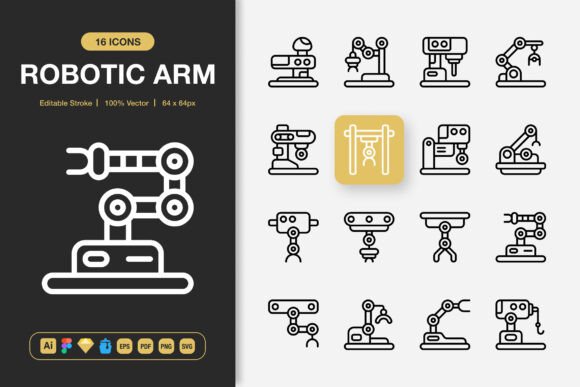
At first glance, outline icons may appear simple, but their strength lies in their clarity and adaptability. The Robotic Arm Outline Icons set provides a complete series of drawings that represent robotic arms in various poses, angles, and functional contexts. Each icon uses a consistent stroke weight, ensuring that when you combine multiple icons in a single layout, they maintain a unified visual rhythm. The minimalist approach reduces visual noise, allowing the subject—the robotic arm itself—to remain the focal point.
This icon set is built for flexibility. The files are fully editable, meaning you can adjust stroke thickness, change colors, rotate elements, or combine icons to create new compositions. Because the set includes source files for Adobe Illustrator, Figma, Sketch, and Iconjar, as well as EPS, PDF, SVG, and PNG formats, you can work in your preferred environment without compatibility concerns. The transparency-supporting PNGs range from 32px to 512px, covering everything from tiny UI buttons to large banner prints.
Creative Possibilities Across Different Platforms
The minimalist nature of robotic arm outline icons makes them ideal for a variety of applications. Below are several practical ways you can integrate this collection into your projects.
Websites and Mobile Applications
User interfaces benefit from icons that are both recognizable and unobtrusive. Robotic arm icons can serve as navigation markers for sections like “automation,” “manufacturing,” “technology,” or “engineering.” Because the outlines are thin and clean, they pair well with modern flat design or material design systems. You can also use them as empty-state illustrations or loading indicators. For app developers, the SVG files allow scaling without pixelation, and the Figma file makes collaboration with team members straightforward.
Infographics and Data Visualization
When presenting statistics about robotics adoption, industrial efficiency, or automation trends, a cohesive set of icons helps transform dry numbers into engaging visuals. Use a robotic arm icon next to key metrics, or repeat the icon in different sizes to create a visual hierarchy. The editable stroke feature lets you match the icon weight to your infographic’s line style, creating a consistent look across charts, diagrams, and callouts.
Social Media Graphics and Blog Posts
Content creators and marketers can use robotic arm outline icons to make posts more scannable and professional. A single icon at the top of a quote card, a row of icons dividing a list of tips, or an icon placed beside a headline—all these small touches add polish. Since the icons come with transparent PNGs, you can drop them directly into Canva, Photoshop, or similar tools without extra editing. For LinkedIn articles or Twitter threads about innovation, these icons signal a tech-forward brand voice.
Print Materials: Flyers, Posters, and Banners
Print design demands assets that reproduce well at various sizes. The EPS and PDF versions of this icon set are vector-based, so you can scale a robotic arm icon to poster size without losing sharpness. Combine multiple icons to build a background pattern, or use a single large icon as a hero element on a flyer promoting a robotics workshop. The 512px PNG files are also suitable for high-resolution printing when vector software is unavailable.
Books, Ebooks, and Educational Resources
For educators and authors writing about STEM topics, robotics, or engineering principles, outline icons are perfect for chapter openers, activity pages, or margin callouts. Their simplicity keeps the focus on the text while adding visual interest. You can even use the icons as templates for coloring pages or line-art exercises for younger learners, thanks to the editable stroke that allows thinning or thickening lines.
Adapting the Icons for Different Audiences
One of the strengths of this icon set is its cability to adapt to various communication goals. Depending on your audience, you can customize the icons to strike the right tone.
For corporate and professional audiences, keep the icons monochrome or use corporate colors. The clean lines convey precision and reliability, which aligns with business presentations, whitepapers, and internal documentation. Use the Adobe Illustrator source file to replace stroke colors with your brand palette, and ensure consistency across all materials.
For creative and younger audiences, consider applying gradient fills or duotone effects. While the icons are outlines by default, you can easily add solid fills or layered backgrounds. The Figma and Sketch files support these adjustments quickly. For social media campaigns targeting millennials and Gen Z, pairing robotic arm icons with vibrant gradients or bold typography creates a contemporary feel that stands out in feeds.
For technical or specialist audiences, use the icons as part of diagrams or schematics. Because the set includes multiple arm configurations, you can illustrate different mechanical concepts—degrees of freedom, joint movements, or end-effector types. The PDF file is particularly handy for sharing with clients who may not have design software.
Practical Workflow Tips for Maximum Consistency
Working with a large icon set requires organization to maintain visual harmony. Here are a few recommendations for keeping your projects clear and effective.
- Establish a stroke weight early. Even though the icons come with an editable stroke, decide on a pixel width (e.g., 2px for web, 3px for print) and apply it to all icons from the start. This prevents visual inconsistency across your layout.
- Use a consistent color strategy. Choose a primary and secondary color, or stick to a single neutral tone. Outline icons work exceptionally well with a minimal palette because the negative space does most of the heavy lifting.
- Set alignment rules. If you are placing icons in a grid (e.g., on a landing page or in an infographic), define how they should be aligned—centered, baseline, or top-aligned—and stick to it. The PNG files with transparency help you place icons precisely.
- Scale with intention. Avoid scaling icons too small where thin strokes become invisible, or too large where they look sparse. Test your sizes early in your chosen medium, whether that’s a mobile screen or a printed poster.
- Create a master library. Import all icons into a single Figma or Illustrator file and create a grid or symbol set. This allows you to drag and drop icons into new projects quickly, saving time and ensuring you always use the most up-to-date version.
Exploring Variations and Combinations
Outline icons are modular by nature. You can combine multiple robotic arm icons to suggest movement or sequence. For example, placing three icons in a row with slightly different arm angles creates a visual story of lifting, rotating, or placing. This is particularly effective in infographics or animated presentations where you want to guide the viewer’s eye.
You can also mix the robotic arm icons with other minimalist icon sets—such as gears, circuits, or tools—to build a comprehensive visual language for a tech brand. Because all icons share a similar stroke style, they will feel cohesive even if sourced from different collections. The Iconjar file included in this set makes it easy to manage and sort icons, so you can build a custom library over time.
File Formats and How to Use Them
Understanding the included files helps you choose the right format for each stage of your workflow.
- Adobe Illustrator source file: Ideal for advanced editing, creating symbols, and preparing final vector artwork for print or screen.
- Figma file: Perfect for collaborative web and UI projects. You can copy frames directly into your design system.
- Iconjar file: A great way to organize icons as a searchable library for ongoing use.
- Sketch file: Suitable for macOS users working in interface design.
- EPS Version 10: Legacy compatibility for older design software or print workflow requirements.
- PDF file: Useful for client previews, print proofs, and presentations without needing editable layers.
- SVG file: Best for web development, inline use in HTML, or scaling infinitely.
- PNG transparency files: Available in 32px, 48px, 64px, 96px, 128px, 256px, and 512px for quick drop-in use in any application.
- Readme.txt: Provides a summary of usage rights and file organization.
This variety ensures that whether you are a front-end developer embedding SVG directly in code, a print designer working in InDesign, or a marketer quickly assembling a social media post in Photoshop, you have the right format ready.
Keeping Your Work Original and Audience-Friendly
While using a pre-made icon set is efficient, adding your own touches keeps the final output distinct. Change stroke colors to match a specific campaign, combine icons with custom typography, or place them inside geometric frames. The editable vector files make these tweaks easy even for designers who prefer not to create from scratch.
For audience-friendly design, always test your icons at the actual size they will be viewed. On mobile screens, a 32px icon must remain legible. In large poster formats, check that the thin lines do not fade against busy backgrounds. The multiple PNG sizes included give you a head start on this testing process.
If you are designing for accessibility, consider increasing stroke contrast against backgrounds. Outline icons can be paired with subtle background shapes, such as circles or rounded rectangles, to ensure they meet contrast requirements without losing the minimalist aesthetic.
Ultimately, the Robotic Arm Outline Icons set is more than just a collection of generic images. It is a flexible design resource that respects your creative vision while providing the technical reliability needed for professional projects. With careful application, these icons will not only enhance your current work but also simplify your future design workflows.